

Three long bus rides, seven cramped jeeps, seven jumbled tricycles, ten boats through differing waters, uncountable bus stops, one rented van along with two comic Batangeño drivers, two bustling cities, five sleepy towns, five islands, two rugged mountains, five old and new churches, one rocking festival, five ref magnets, one shirt, three Starbucks City Mugs, three weighty cameras, a bagful of snorkeling gear, an officemate, three cousins, numerous uncles, one aunt, one brother, uncountable strangers, and me and my two ultra-bruised feet; finally, a sketch of my nine-day trip through Southern Luzon.

I’m opening a new segment in my journal about my favorite collectibles during my trips around the country. Besides Starbucks City Mugs, which are superlatively expensive as souvenirs, I also collect ref magnets.
Some may be wondering why ref magnets instead of the more popular keychains. Well, since I only have one key and a few bags to hang keychains at, I don’t know how or where to display them. Our refrigerator on the other hand has lotsa space where I can stick my magnetic mementos, so its ref magnets for me.
Without further ado, here’s my latest haul from my Southern Luzon escapade last summer.
MARBLE DOLPHIN | Banton, Romblon
I got this at Banton’s Poblacion. There were only a few souvenir shops in town since it is really not a touristy location, I guess most of these shops cater more to the returning locals from the metro than to tourists. Most, if not all of the wares being sold here are made of marble, which is the industry Romblon is most known for. There were lots of keychains and all sorts of gift items but I was unable to find any ref magnets. What I did find was a nicely designed keychain with a flat back where I can glue a magnet over for an instant ref magnet souvenir.
The keychain cost me Php20.00, the engraving was an additional P15.00 (I also had other items engraved, so I’m really unsure how much it would be if it was just the keychain). The finished product turned out pretty well.
MORION CENTURION | Boac, Marinduque
Painted on a chopped piece of wood, this was the second ref magnet I got for the trip down south. The painting shows a colored profile of a Morion, which were then roaming the streets of Marinduque; I was just in time for the annual Moriones Festival. I also saw a few ref magnets with more intricate designs but they were too big for my liking. The size of this one was just right for me and the price was extremely cheap too at Php10.00. This is the most inexpensive ref magnet I have bought to date.
WOODEN TURTLE | Caramoan, Camarines Sur
I was having a hard time finding magnets in Caramoan. Most of the things they have are the generic fish-types stamped with the locale that you can find almost anywhere you go in any touristy place in the country. I was lucky to find this small wooden turtle with a real shell back on one of the shops there, it was the only one of its kind left and I snagged it immediately. Got this for Php35.00, not bad.
BLUE DOLPHINS | Caramoan, Camarines Sur
I found this at Bed & Dine’s restaurant while we were having our almost-midnight kinalas and Bicol Express. It looked pretty and was quite hefty being made of clay (I think). The price was quite hefty too at Php45.00. I found later after opening the plastic that it was made in China, the Caramoan brand was just added to the thing (I felt ripped off hehe).
CAGSAGWA RUINS | Naga City, Camarines Sur
I was looking for a Mayon Volcano magnet at Mayon’s Skyline View Deck, I was thinking since we were at a tourist hub right at Mayon Volcanon itself; they would probably have cool ref magnets depicting the famous volcano. I was totally disappointed though upon finding their gift shop bare of almost everything. They could have made a killing here selling souvenirs, but sadly their gift shop was totally a devoid of anything (you can hardly call it a gift shop).
I found this great looking magnet at the Naga City market. I was hunting for a Naga City magnet and was having a hard time finding one (I actually didn’t find one) when I saw this huge Cagsagwa Ruins magnet hanging on one of the shops fronting the street. I’m glad I didn’t go home without a Mayon Volcano keepsake.


One reason I was so excited in revisiting Naga City was because of the (gasp) Starbucks City Icon mugs that I collect. It was gonna be my 8th mug in the series, and there were only 11 of them. Just three more mugs to completion and I can almost hear Tyler Durden say never be complete, haha.
So before going back to Manila, I, along with my cousins dropped by the local Starbucks Coffee in the city after filling our stomachs full of Kinalas (Bicol’s version of Mami) a hole in the wall near the Naga Cathedral.
The mug rack was the first thing my eye hunted for as I entered Naga’s Starbucks. And there it was, a rackfull of orange-colored coffee mugs printed with Naga’s delicacy, the pili nut. I grabbed three mugs like there was no tomorrow before heading to the counter to order some fraps.
Pili (Canarium Ovatum Engl.) is a tree indigenous to the Philippines and it is in Bicol where it is abundantly grown. Most of its produce, the pili nut, are made into snack delicacies and can usually be found in pasalubong (keepsake) shops in the city centers.
I was actually surprised at the icon showcased on the mug, as I thought it would showcase the Penafrancia Festival which is really what Naga is more known for (well, at least for me hehe). Nevertheless, the pili nut, is still a pretty good icon for the city, I guess.


Starbucks Coffee Naga City
Address: Magsaysay Avenue cor. Dayangdang Street
Naga City, Camarines Sur
Bicol Region

It seems everywhere I look; churches follow me at every corner I take in Naga City. Worship places seem to grow out of its streets like mushrooms on farm fields. The last one I was able to visit, not out of disinterest to the other ones, rather than due to lack of time, was the Basilica Minore de Peñafrancia or the Basilica, as the locals refer to it.

Construction of the church was started in 1976 due to the increasing numbers of devotees flocking Naga City. It was finished five years later, after much delay due to financing. It was lifted to a title of a Basilica Minore after a request to Rome by Leonardo Legazpi, the third Archbishop of Caceres in 1985.
The basilica appears as new as the year it was built. The lawn that surrounds it was as verdant as it can be and the walls of the church look fresh and clean. The architecture is simple and clean-cut, ornaments on the church is limited to trims and windows that pierce its walls.

Next on my blitzkrieg list of churches to visit on my last day in Bicol was the region’s oldest church. Fronting a tree-laden plaza and sporting an unpainted neo-classical looking exterior, one would really not think the San Francisco Church to be older than the Naga Metropolitan Cathedral, nor even the oldest in the whole of Bicol.

The church really doesn’t look old. Its exterior, although rough-looking in its weathered concrete facade, has none of the decay that is usually found on old cathedrals.
I love bare concrete facades. In my opinion, it looks purer, has more character, and looks more honest than painted ones, which most of the time looks plasticky and fake (if you’re not convinced, google Tadao Ando’s work in Japan). I fervently hope the church remains in its unpainted state.

I was nursing a major hangover on the final date of my nine-day sojourn from Romblon to Naga, I think I drank too much during the previous night’s session. I was supposed to wake up early and explore the city, but as expected, I woke up quite late (with a headache to boot).
I arrived at the Naga Metropolitan Cathedral at almost 10am. The sun was already pressing hot to my skin as I raised my camera and took my first photograph of the day. The Bicol Mass was still ongoing as I took the time shooting the cathedral’s facade.

Instead of taking the shorter and more straightforward route back to Naga City, we took the longer road and detoured to check the vista along the eastern coast of Sagñay (pronounced sangay), a sleepy municipality in Camarines Sur.
This was originally our destination instead of Caramoan, the plan being to beach at the rocky shores of Barangay Patitinan, then head out to the nearby Atulayan Island. My uncle decided against it at the last minute since we’ve already been here the last time we went to Bicol (I can still recall our picnic at the nearby cold spring covered by shady trees just a few meters beside the sea, and snorkeling the afternoon away at its starfish-laden waters).

Our van snaked along the road, ever upwards; our driver, still unable to believe that we were climbing the perfect cone of one of the country’s deadliest volcano. Our current destination was a park halfway through its slopes, the Mayon Skyline View Deck.
Mayon Volcano has erupted forty-nine times in recorded history, the most recent of which was in 2008. According to Wikipedia, it is currently weakly erupting since January this year and may be building up to a massive on some time in the near future.

Alarms sounded one after another as the clock struck 3AM. It was our last day in Caramoan and we have to make the first trip back to Sabang port in order to reach Mt. Mayon before noontime. Everyone scrambled to prepare their bags and luggage and an hour later, we were roaring off on two tricycles to Guijalo Port. I’ve never seen my cousins and aunts prepare this fast, knowing them, it was almost a miracle, haha.

It was already nine in the evening and we’ve just finished raiding all the souvenir shops we can find for our pasalubong and keepsakes. Ref magnets checked, keychains checked, t-shirts checked, our grumbling stomachs unchecked.
We’ve been passing by a restaurant advertising cheap kinalas and loglog ever since day one of our Caramoan trip; and I guess there was never gonna be a better time to check it out after all that walking.
Kinalas and loglog are Bicol’s version of mami. They’re basically the same except for the brown gooey stuff they pile on top of the soup (I think, do correct me if there are other differences). The basic bowl is called loglog, and kinalas is the special version which has shredded beef included in the mix.

Being stuck for a whole day on an island full of beautiful people can never be a bad thing. I was at Caramoan’s Bagieng Island (also known as Sab-itan/ Sabitan Laya Island), unable to hop to the next island on our list due to the ebbing tide. So what to do? I whipped out my camera, attached my telephoto lens and started photographing people from a distance.


The sun was scorching the beach of Bagieng. We just had a lunchful of bicol express, ginataang palos (eel on coconut milk), and squid with veggies. I was full and contented as I sat on the beach under the island’s many rock formations, totally unaware as my eyelids fell and sleep engulfed me.
We started for the island at eight in the morning, plying the northern portion of the Caramoan waters. The hour-long ride went smoothly as we passed the jagged rock formations that rise up on the island’s eastern end and docked on its cream-colored shore.
With the tent put up, I unhurriedly went for a walk on the northwestern shore of Bagieng.

It was nine in the evening and we were sitting on a curb at one of Barangay Tawog’s sidestreets, eating a cup of ice cream from a nearby store. We just had dinner at the nearest carinderia and we were contented with the cheap ice cream we were having.
Barangay Tawog in Caramoan is where everyone’s at; this is where island-hopping tourists lodge, buy souvenirs, dine, drink and hang around at. Don’t expect Starbucks Coffee shops or swanky accommodations though. The place is still quite provincial, with eateries more like cafeterias, and lodgings, renovated homes.

We were racing against the sun across Caramoan’s concrete roadways, cameras and tripods in tow, to catch the brick-laden cathedral we saw at the town earlier for the sunset.
We just came from a day of island hopping and since we were not able to finish off our tour on a blazing sunset, we planned to make do with the town’s church instead.
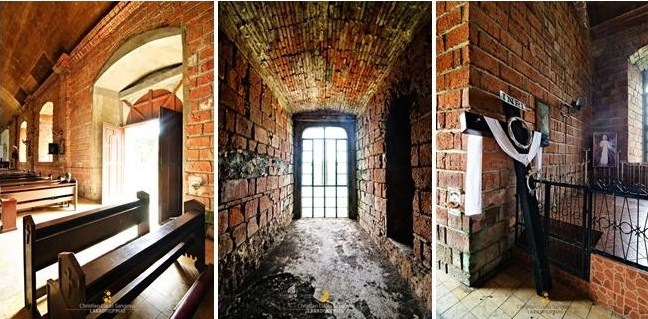
The church looked old, and I found out that indeed it was.
Founded in 1619 by the Franciscans, its walls are made of bricks punctured by arched doors and windows. The brick walls were also reflected inside.
One thing I found really interesting is its ceiling which were made of unpainted patchwork of plywoods. Imagining an unpainted plywood-clad ceiling may not bring to mind grand things, but once you see the pattern it makes on the church’s curved ceiling, you’d see what I mean.

The blue-green waters of the Minalahus cove enveloped my body as I jumped from our boat to access the island.
A few minutes ago, we were stuck waiting, a hundred meters from the shore, from our outrigger boat. The nearby cove was too shallow to navigate and we have to wait for the tide to rise back up. I was itching to start snorkeling; our boatman said that this was the place to do some underwater fun.
Not wanting to wait any longer, I opted to just swim all the way to the shore.

I was panting like a dog as I reached the peak of Matukad Island’s jagged karsts, I’m definitely not a mountaineer, let alone a rock climber. This relatively low climb at the northeast corner of the island was totally dangerous. As I rested my unwieldy legs, I was thinking to myself how I got myself into this situation.
We started off from the town of Caramoan earlier on six-seater tricycles then transferred to a middle-sized outrigger boat at the mangrove-speckled port of Bikal. It was already pretty late and the sun was already high up. We circled the coasts of Bikal and Paniman, and after more than an hour of being splashed with saltwater, our boat docked at the wavy shore of Matukad Island.
Matukad, according to our guide means mataas, and I can definitely see why. The island is dotted with sharp rocky outcrops.

After much asking along the busy old streets of Boac, I finally found a jeep to Cawit Port. I was originally headed for the harbor of Balanakan, but was unable to locate the jeepneys that head to that pier due to the rerouting made for the Moriones Festival.
The streets of Marinduque are actually quite beautiful with old ancestral houses lining its sidewalks. It looks a bit like Vigan City, only busier, no doubt due to the ongoing festivities. I managed to snag the mandatory ref magnet before boarding a jeep.
Thirty minutes of cramped jeepney ride later and I was finally at the docks. I was seated at the farthest end of the overcrowded jeep (they even have makeshift seat at the rear entrance) and I cannot recall how I managed to get out of the vehicle with my backpack, snorkel vest, tripod and beltbag on.

Tyring to squeeze my time’s worth in the province of Marinduque, I quickly searched Google Maps for the towering structure I saw on my jeepney ride from the Port of Buenavista to the main town of Boac. I assumed that it would be the town cathedral, and indeed it was. After witnessing parts of the Moriones Festival, I asked for directions from the locals I passed along the road and I eventually made it to the church’s fortified walls.

The church, it seemed, was once a fortress during the Spanish era. This was quite evident on the rough stone walls surrounding the church yard, and its location, which was on the highest part of town, aptly named Barangay Mataas.
According to the National Historical Institude marker set on its walls, the cathedral was built in 1792. It became a haven for the locals during a Moro attack in the 1800’s and was the place where the Philippine Revolutionary flag was blessed in 1899.

I arrived at Boac at exactly seven in the morning. I haven’t had anything to eat yet since the previous day’s afternoon snack, so before anything Moriones, it was gonna be breakfast first.
I checked out the assortments of carinderia in the area including a mobile Jollibee (it was on a truck, first time I’ve seen one) and eventually settled on a small hole-in-the-wall near the Boac Plaza. Two longanisa, one lumpiang shanghai, a scrambled egg, a cup of fried rice and an instant coffee later (told you I was really hungry) and the Morions started streaming into the streets of Boac.

It was the dawn of the 20th of April, I should have been at Lucena already on my way to Naga but instead found myself at the rooftop of a stranger’s house, shooting the glow of the soon rising sun behind the mountains of Marinduque.
Last night had been a whirlwind.

I really don’t mind spending a bit of time in Marinduque though, what with the ongoing Moriones Festival roaming its turn-of-the-century streets. The problem was where to stay.


