


From the language alone, we knew that we’re now on a different part of Morocco. From French in Casablanca, Rabat, and Sale, the lingua franca changed to Spanish once we arrived in Asilah. And along with the language, we expected the food to somewhat change a bit as well.
 |
| ROASTED CHICKEN IS A STAPLE ALONG THE SPANISH-SPEAKING AREAS OF MOROCCO |
We had rice on our first meal in Asilah, so we’re definitely loving it here! We sat down at Ali Baba [35.463799, -6.037815], seeing their prices to be reasonable enough. We asked for turmeric fried rice paired with roasted chicken and fries (MAD 30.00 | USD 3.00)—a staple among the Spanish-speaking areas of Morocco. It was kinda strange since the menu was in French, but they were speaking to us in Spanish. Serving size is generous so we decided to scrimp and share. The roasted chicken is extremely flavorful, we decided to eat at the same restaurant the next day.

I cannot remember how Asilah got squeezed in into our itinerary—a benefit of traveling for a long period in Morocco. We were supposed to head to Chefchaouen after staying in Rabat for three days but here we were, walking the final two kilometers from the train station to town—the sparkling sea on our right, a field of wildflowers with a couple of camels grazing on our left. It all sounds very beautiful and all, except we’re hauling all our belongings with us in the middle of the warm/cold Moroccan afternoon. This town better be worth it.

After having an introductory taste of Moroccan food during our four days in Casablanca, we wanted to advance our taste buds to a few more local dishes. Rabat was our second city for our month-long trip around the country, and its bustling old medina was the perfect grounds for another round of food tasting, Moroccan style.

Should we go? That was the question we were trying to answer as we dilly-dallied whether to cross the street onto the tram platform or go back the way we came. The town of Salé was only a few minutes away by tram, and why we were debating on whether we should visit or not, baffled even us. The deciding point was the tram fare, a measly MAD 6.00 (USD 0.60). We went.
 |
| ATYPICAL ALLEY IN SALE |
Salé literally sits right beside Rabat, separated only by the Bou Regreg River. It is more of a residential city than Rabat, in fact, most people who work in Rabat lives in Salé. But surprisingly, tourists who visit Rabat, hardly ever take a quick side trip to Salé. Being indecisive ourselves, I really can’t tell why. Besides being older and more historic than Rabat, it’s just there!

Having spent four days in Casablanca—three days too long, according to legit traveler standards—we thought of skipping Rabat, Morocco’s capital city, and instead, head straight to Chefchaouen, the country’s famous Blue City. We’ve been reading a bit before going, and Rabat, being one of the four Imperial Cities of Morocco (the other three being Marrakech, Meknes, and Fes) and the UNESCO World Heritage Site inscription attributed to its medina and surrounding sites decided it for us. We’re going.
Our Rabat three-day itinerary basically went like this. The first day, half of which was spent transferring from Casablanca to Rabat, was spent roaming the northern side of the Old Medina—the cliffside area, lighthouse, beach, the kasbah, and parts of the medina. The second day, we went to the farther places in Rabat, visiting the Hassan Tower, the neighboring town of Sale, and the Chellah. On the third day, we roamed the Old Medina again right after breakfast, then prepared for our next destination, Asilah.

We eat almost anything. And during our Moroccan four-day Casablanca tour opener, we wolfed down every new thing we see, from McDonald’s burgers we haven’t seen elsewhere but in Morocco, to mystery meats being grilled along the corners of the medina. We really don’t have much money, so we almost exclusively ate along the streets and alleys of Casablanca. No fancy restaurants for us—even if we really wanted to. But okay, no, we don’t like eating on fancy restaurants, lol. We like to eat what the locals eat, and that includes fast food.
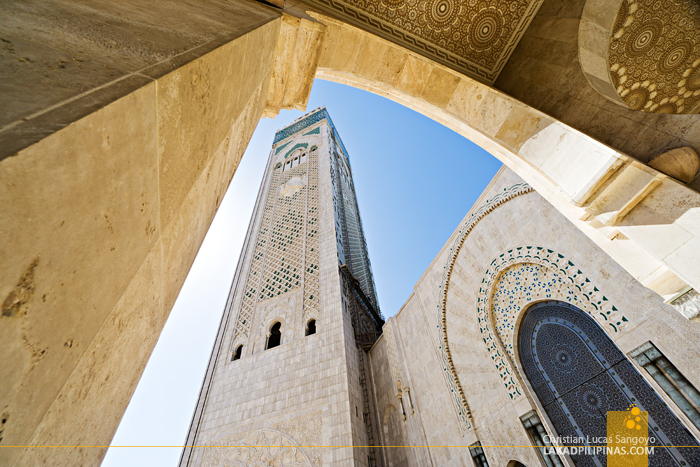
It was totally unexpected that we’d be scared of Casablanca. Isn’t it supposed to be all glorious beaches and syrupy romance? But that’s what we felt the moment we came out of the train that brought us from the airport to the Casa Port station. Without saying a word to C, she also sensed it. The guide books and blogs don’t mention it, but there’s something about this city that makes you keep your phone in your pocket and your cameras zipped tight inside your bag.
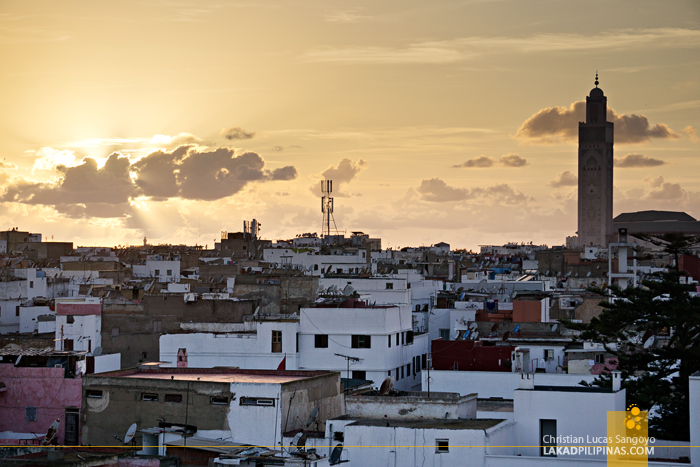 |
| SUNSET AT CASABLANCA’S MEDINA |
We arrived at Morocco’s largest and one of its oldest cities after a grueling twenty three-hour flight from Singapore to Casablanca via Jeddah. Tired but elated that we’re finally in Morocco, we stepped out of the plane and got the shock of our lives. It’s cold. Like sixteen degrees cold. Like total ignoramuses, we expected Africa to be hot, especially during the summer months. The summer months in South East Asia, that is. We’re in Northern Africa, dufus, and we didn’t have a single winter clothes with us.
EN ROUTE | Singapore to Morocco via Jeddah ~ Why We Almost Gave Up
[BEYONDPH] Monday, February 18, 2019
The objective, to fly from the Philippines to Morocco, the cheapest way possible. The plan, roam around South East Asia first, then from Singapore, take a connecting flight to Casablanca via Jeddah in Saudi Arabia. The problem, a lot.
Singapore is one of the cheapest places to fly off en route to Morocco, so we made sure that our route for our two-month annual summer trip, SEA2africa, lands on the Lion City midway through. From Manila, we flew to Bali, then East Timor, before finally flying to Singapore. This is it. We’re finally bound for Morocco!

Our favorite haunt for food when in Singapore are its hawkers. They’re cheap, readily accessible, and quite delicious. But sometimes, most especially when we’re with friends, we try out restaurants above our budgetary constraints. Well, when they treat us for meals. Another place we also frequent besides these are the numerous food courts usually found inside mall basements. While we still prefer Singapore hawkers over those two. It’s such a comfort to eat your favorite hot dishes on cool air-conditioned rooms, lol.
ASIAN FOOD MALL AT LUCKY PLAZA
ADDRESS: 304 ORCHARD ROAD | OPENING HOURS: 10:00 AM TO 10:00 PM | GPS MAP: 1.304334, 103.833757
Lucky Plaza holds the number one spot for Filipinos in Singapore. And for this reason, Jollibee built its first outlet in the country inside its doors. It’s our go to spot, whenever we miss Chickenjoy during our annual two-month long summer trip (if we do drop by Singapore, that is).
In all fairness, even though their Jolly Spaghetti (SGD 4.50) doesn’t compare to the original ones in the Philippines, their Chickenjoy (SGD 7.00, 2 pieces), including their gravy, taste exactly like those in our home country.
Besides having Jollibee, the Lucky Plaza food court also has a lot of stalls selling what you’d normally see on a hawker center, sans the usual Singaporean warm weather. We were able to try a bowl of mee rebus and a plate of rendang. Like on most places, it can be a hit or miss. The former was a miss, the latter, a hit.
 |
| ASIAN FOOD MALL AT THE BASEMENT OF LUCKY PLAZA |
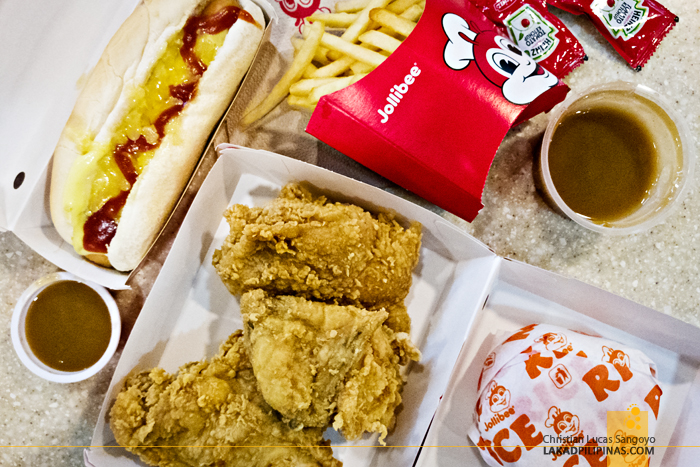 |
| JOLLY HOTDOG, CHICKEN JOY, AND FRIES FROM JOLLIBEE |
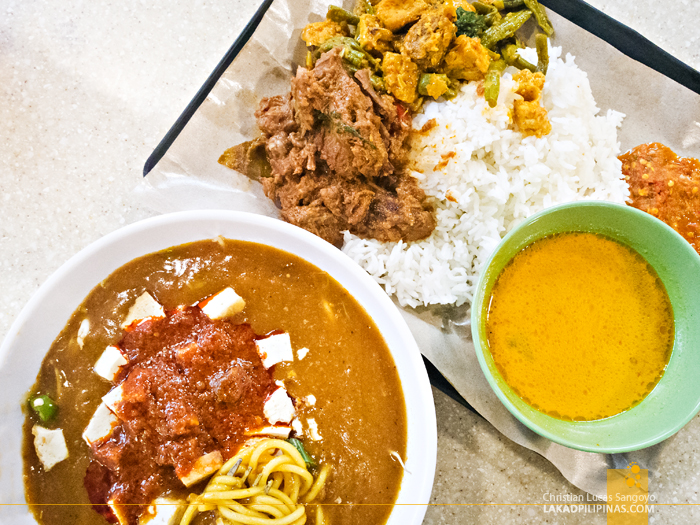 |
| MEE REBUS AND BEEF RENDANG WITH RICE AND VEGGIES |
TANGS MARKET AT TANGS PLAZA
ADDRESS: 310 ORCHARD ROAD | OPENING HOURS: 10:30 AM TO 10:00 PM | GPS MAP: 1.304746, 103.832925
I cannot remember why we ate at the Tangs Plaza food court which they dub as Tangs Market. It may be that it’s just a stone’s throw away from where we were staying, YOTEL Singapore, the last time we went to SG. My travel partner told me that I went hangry after visiting the Singapore Botanic Gardens and that’s where we were the moment my tummy rumbled.
Anyhoo. Their food court isn’t really that large, but selection was pretty okay. We went for Fei Siong’s Hainanese Curry Rice. We chose the chicken cutlet (SGD 4.30), the cheapest among the bunch. The photos advertising it looked much more delicious that it actually is, but really, it’s on the above average side.
 |
| TANGS MARKET AT TANGS PLAZA ALONG ORCHARD ROAD |
 |
| HAINANESE CURRY RICE FROM FEI SIONG STALL |
TOAST BOX
ADDRESS: EVERYWHERE IN SINGAPORE | OPENING HOURS: FROM 7:30 AM TO 10:00 PM
One of our friends’ go to spot when in Singapore is Toast Box. Since they’re really not the most adventurous when it comes to food, the familiar name (since we used to have these in the Philippines), probably draws them. We’ve tried this popular Singaporean restaurant on their Marina Bay Sands and CHIJMES branches and their menu varies a bit from those in Manila.
My finger always lead me to point to their mee rebus (SGD 6.70) and laksa (SGD 6.80), while C usually goes for their mee goreng (SGD 6.20) which has luncheon meat included, and adds an order of traditional kaya toast (SGD 1.90). For drinks, their Milo Dinosaur (SGD 3.40) is the bomb.
 |
| TOAST BOX IN CHIJMES |
|
| SURPRISINGLY GOOD LOCAL DISHES AT TOAST BOX SINGAPORE |


SINGAPORE | How I Dragged my Wife to the Singapore Botanic Gardens
[BEYONDPH] Thursday, February 14, 2019
I’ve been nagging my travel partner, like forever, for us to visit the Singapore Botanic Gardens every time we take a trip to the Lion City. She would say yes, but that would be it. We would always skip it on the itinerary. One time, she ‘fessed up, “what the heck are we gonna do there?” She exasperatedly asked me. Well. I really have no idea, I just wanted to see it since it’s the only UNESCO World Heritage Site in Singapore. Honestly, I just wanted to cross it off my list of World Heritage Sites to visit, lol.
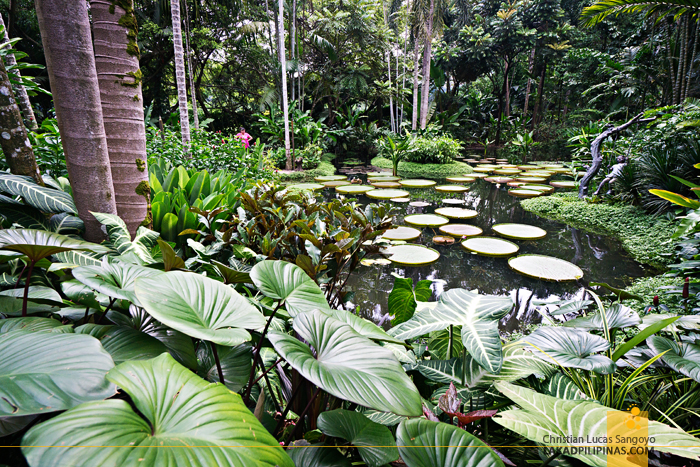 |
| VISITING THE SINGAPORE BOTANIC GARDEN, AT LONG LAST |
So, after much more nagging, we finally went to the gardens, the oldest of its kind in Singapore, like 158 year-old old. This garden is older than my grandma’s rheumatic grandma. I was readying for a good belting of I-told-you-so, after our visit.
SINGAPORE | YOTEL ~ the Niftiest Hotel on Orchard Road
[HOTELS & RESORTS] Tuesday, February 12, 2019
Straight from East Timor, we flew back to Bali for a couple of days before taking another flight to Singapore. It’s the third country for our SEA2Africa two-month summer trip, and why Singapore? Well, next to Malaysia, we love Singaporean food! Plus, after almost a month of traveling, we’re hankering for the comfort of a first-world country—spell, fast food.
 |
| YOTEL SINGAPORE ALONG ORCHARD ROAD |
So, we’re spending four days on this leg of our trip and our lodging of choice is YOTEL Singapore. YOTEL? The name sounds cool, indeed. Tucked on one of the quieter parts of the bustling Orchard Road, the hotel is sleek and very modern. It has branches in London, Boston, Amsterdam, and New York, and this is the first one to open in Asia.

It took several days for us to finally hit the beaches of Dili. One of the main reasons why was due to its location. While it is right within the city limits—heck, we can even see it from the boulevard in front of the Palacio Governo—getting there by foot, which was our main mode of exploring Dili, was out of the question. So we asked around, not wanting to flag a taxi to go there, and eventually found it was possible to get there using East Timor’s public transport, the microlet.
 |
| THE BEACHES OF DILI, BORDERED BY MOUNTAINS |
 |
| EAST TIMORESE KIDS PLAYING ON A WEEKEND |
 |
| THE BEACHES OF DILI ARE WITHIN THE CAPITAL CITY |
The beaches of Dili, East Timor’s capital city, is located on its eastern part. There are a couple of beaches right at the center of Dili, but these have course brown sand and almost no one swims there. To get to Dili’s white sand beaches, we took a white, number 11, microlet which passes along Largo de Lecidere, and alighted at the corner of Bidau Street. We then took a blue microlet that went straight to the Dili Cristo Rei jump-off where the Jesus Beach is located. En route, we also passed the Areia Branca Beach and an unnamed small pocket-sized beach along the road.

It was a Sunday and the plaza near the Palacio de Governo at the center of Dili, Timor Leste’s capital, was teeming with families hanging out at the park. Afternoon mass has just commenced and everyone was at their Sunday’s best. Kids were playing along the grounds while parents watched, sipping on hot bowls of bakso soup from a nearby street vendor as they do. We were watching everything with joy. Delighted at the seemingly simple way the Timorese people enjoy life.
As sundown commenced, we went past a thin clump of trees from the park and wandered into the coast. The beach, though rugged, was very clean. Which was surprising, Dili being a capital city. Well, I guess it’s really not a city city. There’s no CBD, the skyline is devoid of any skyscrapers, there are no malls, and traffic jams are virtually unknown to this place. Everything feels very provincial. And in a good way.
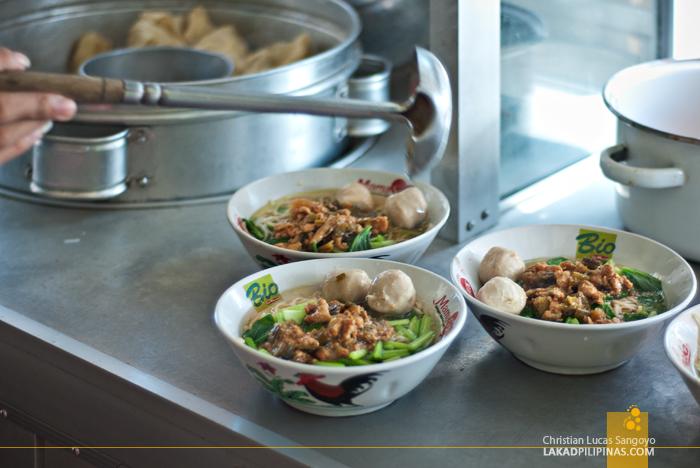
Food isn’t really the first thing that comes to mind when one speaks of Bali. What this island paradise south of Indonesia conjures up are images of white sandy beaches filled with skimpily-clad bodies and moss-laden temples perched on cliffs. Bali has become such a popular year-round destination for tourists that modern air-conditioned restaurants and popular fastfood places can be found just about anywhere. But dig deeper through the local eateries they call warung and you just might be surprised to find something unique to eat in Bali.
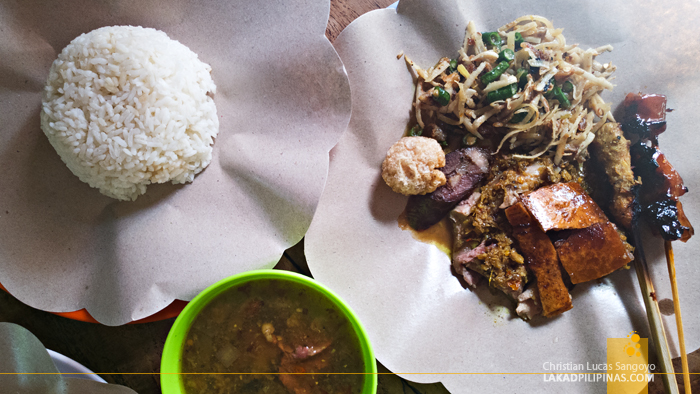 |
| BALI’S INFAMOUS BABI GULING |
Yes, they do serve local dishes on the many fancy restaurants in Bali, but for a more local taste—which is a lot easier on the wallet, by the way—the way to go is to eat where the locals does. Be brave. Go down and dirty, and legitly eat your way through Bali.
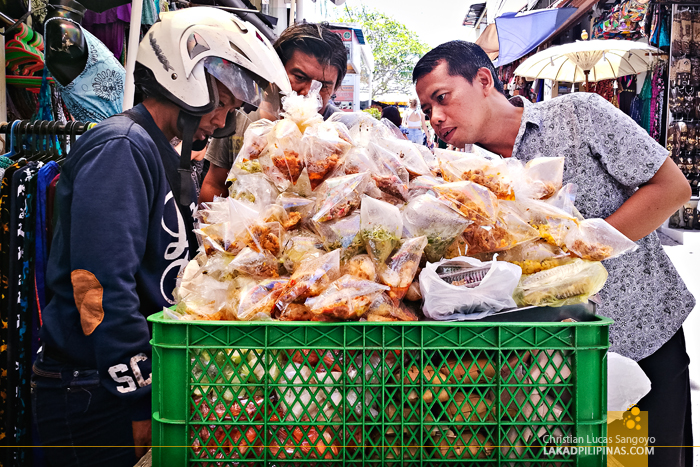 |
| A TYPICAL HAWKER SELLING LUNCH ON A MOTORBIKE |
From my observations, Balinese dishes are cut into three categories—rice meals, noodles, and soups. That’s not discounting snacks and desserts, of course. The difference between the food here to the rest in Indonesia is that they do serve pork, Bali being Hindu instead of Muslim. The taste usually gravitates to a mix of salty and mild spiciness with nary a note of sweetness. It’s a tad similar to the food in Malaysia, albeit with the flavor and spiciness toned down in half. Eating in Bali is generally cheap, with a serving at a warung costing at an average of IDR10,000.00 to IDR20,000.00 (USD0.75 to USD1.50)

Mention Bali and the first things that come to mind are its white sand beaches and the hundreds of ornate temples that dot its landscape. But there’s more to Bali than these, and no, it’s not babi guling—although that porky delight is indeed another aspect of the island worth considering. It’s the traditional Balinese villages that still celebrate the way life was on the island before hordes of tourists started invading this paradise.
 |
| COLORFUL TRADITIONAL WOODEN MASKS BEING SOLD ON THE VILLAGES |
During the course of my visits to Bali, I’ve visited only two of these so-called Bali traditional villages. There are more, like the Trunyan Village which has the custom of leaving their deceased above ground, a cloth and bamboo canopy its only cover, to the more famous jewelry-making village of Celuk and the culturally rich and more touristy Batubulan Village in Gianyar.

How many beaches are there in Bali? That was the thought that was running through my mind as we savored our last sunset on the island, pastels painting the lower part of the horizon as surfers glide through the curling waves. We’ve just spent almost two weeks on the island, exploring the temples of Bali and waterfalls of Bali, and of course, its beaches. We’ve seen quite a lot, swimming on a few and wishing we actually know how to surf.
INDONESIA | Puri Saraswati Bungalows, Staying at Ubud’s Royal Palace
[HOTELS & RESORTS] Tuesday, January 15, 2019
When was the last time you’ve actually stayed and slept on a palace? When was my last? Well, never, of course. I have never slept on a palace before like the rest of the proletariat. But checking in at Ubud’s Puri Saraswati Bungalows, I’m finally getting to sleep on one. And it’s not just any palace, it’s one with a history too.
 |
| PURA SARASWATI BUNGALOWS’ OPULENT VERANDA |
I actually have zero inkling that Puri Saraswati Bungalows is part of Ubud’s Puri Saren Agung, a royal palace built during the 1800’s in the heart of Bali, until reading their in-room menu while munching on a Tim Tam chocolate bar on our room’s very Balinese veranda. It turns out that that the ground we’re standing on used to be the playground for the children’s royalty before it was converted into bungalows which then served as residence to the royal family.
Wow. Just, wow, I said to myself as I reached for another bar of chocolates.
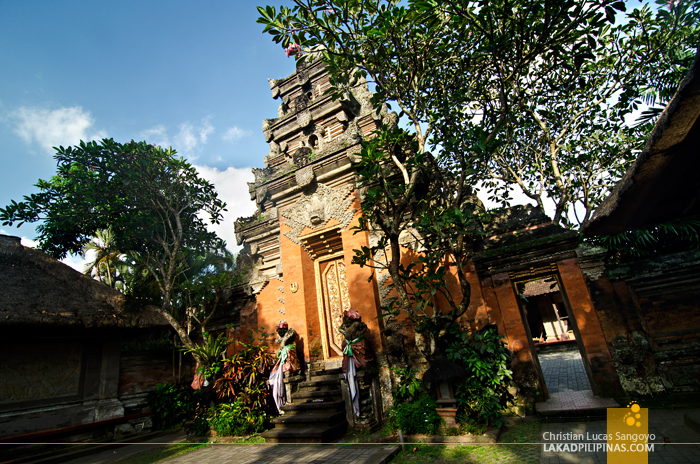 |
| THE ROYAL PALACE OF UBUD |
The bungalows were then opened to the public for lodging in the mid-seventies, with the exception of a few where three generations of Ubud royalties still live up to this day.
 |
| ONE OF THE KORI AGUNG GATES INSIDE THE ROYAL PALACE |
As I was munching on the last of my friend’s Tim Tams (okay, they’re not really mine but he left them on our table), a lady in full Balinese regalia passed and smiled at me. A princess? I thought, as I tried my very best sawasdee krab. I found her the next morning serving us Balinese pancakes on the open-air pavilion in front of our bungalows.
 |
| THE RESORT IS A MAZE OF GARDENS |
We were supposed to stay on a hostel too far away from the center of Ubud downtown when a few of our friends from Manila decided on a whim to drop by Bali for the weekend—we have rich friends like that. Planning the night before to surprise mine and C’s mom, we transferred to Puri Saraswati Bungalows making up lame excuses that they thankfully believed before being greeted in surprise by our friends in the lobby of our new lodging.
 |
| THE BUNGALOWS, WE STAYED ON FOUR OF THESE |
The royal resort has a total of fifteen bungalows and we occupied four of those, our friends indeed has lots of moolah but the nightly rates at Puri Saraswati Bungalows are unbelievably affordable. Really, like half the price of regular hotels in Manila.
 |
| THE ROOMS LOOK BEAUTIFUL IN A DATED KIND OF WAY |
Considering the spaciousness of our room, its authenticity—you just have to see the intricate gilded double-door to each of our bungalows—and its lush garden setting, it’s definitely a steal.
 |
| THE LOTUS TEMPLE AT NIGHT |
But there’s more. Its location is supreme. It’s right in the middle of downtown Ubud, a few minutes’ walk away from two of the best babi guling restaurants on the island, two minutes away from the shopping haven that is Ubud Market, a stone’s throw away from the Royal Palace proper, and right next door to the Bali Lotus Temple. In fact, we were able to enter the inner courtyard of the temple, something most tourists in Bali are not able to, since there’s a private entrance right on the grounds of Puri Saraswati. Definitely sweet.
 |
| TWILIGHT AT THE PURA SARASWATI BUNGALOWS |
We were definitely rarin’ to stay longer and chance upon a gamelan and dance performance on the Lotus Temple, a weekly spectacle, but our friends came on our last day in Ubud and we’re transferring to Kuta the next day. Oh well, sleeping like a royalty, it was fun while it lasted.

Address: 14 Jalan Raya Ubud, Ubud, Gianyar, Bali, Indonesia
Contact Number: +62 (361) 975-164
Email: info@purisaraswatiubud.com
GPS Map: -8.5060787,115.2588963

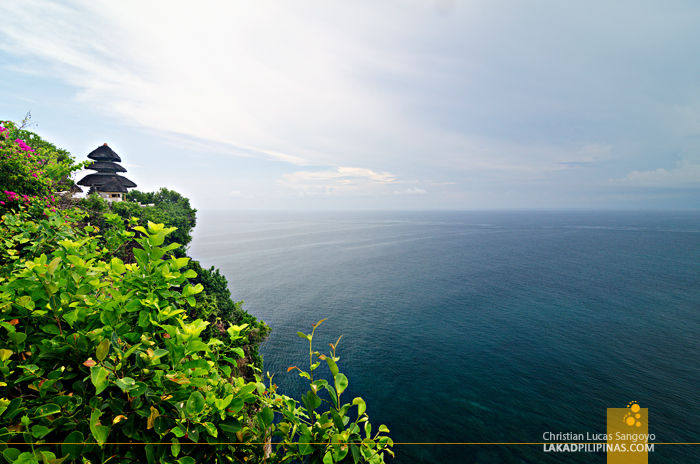
Bali, the Land of the Gods. Separated from mainland Indonesia, this island paradise has a belief unique from the rest of the country, practicing Hinduism instead of Islam. With it comes temples, lots of them, sacred grounds carved on mountainsides, built over lakes, and standing over cliffs, all dedicated to their faith’s gods. And they literally have millions of gods, thirty three million to be exact.
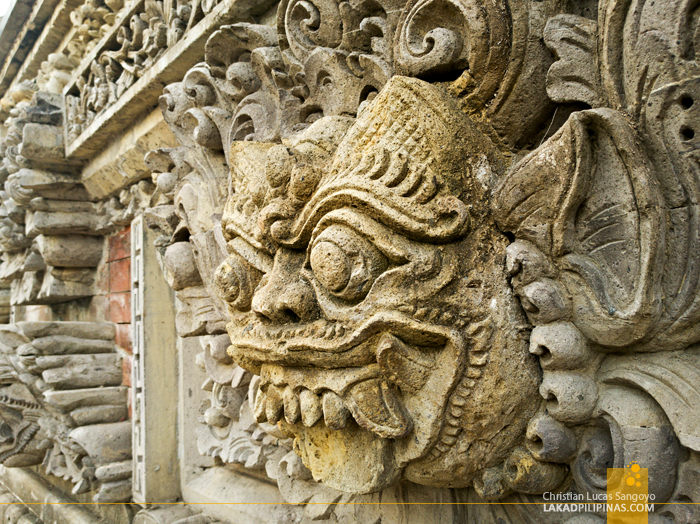 |
| HINDU IMAGERIES ON BALINESE TEMPLES |
Imagine how hard it was for us, unfamiliar with Hinduism, to choose which temples to visit—each Balinese village having no less than three temples on their soil. We consulted guidebooks and read about Sad Kahyangan, the six cardinal temples of Bali, the holiest and most revered pura or temples in the whole of the island. But not all of these are easily accessible, being located on the heart and perimeters of Bali, and this island is huge.


