


What do you eat when you’re in Malabon? Well, pancit Malabon, of course.
The birthplace of pancit Malabon, there are numerous panciterias offering this noodle delicacy in the city. But where can you actually get the best pancit Malabon in Malabon? And what if you don’t live there, are there panciterias offering pancit Malabon that are at par with those in Malabon City? As a kid who actually grew up in Malabon and has tasted innumerable bilaos of pancit Malabon for every occasion—and still wants more—let me share the best pancit Malabon I’ve tried, not only in Malabon itself, but in the whole of Metro Manila as well.
 |
| A TYPICAL BILAO OF PANCIT MALABON |
To be sure, there are still pancit Malabon restaurants that I’ve yet to try. So, I will definitely update this article from time to time as I try new pancit places in the city. If you also have suggestions for the best pancit Malabon, just drop a comment and I will try my best to visit it too.
Note that this list is not in any order. My advice is to try each one out, as they almost always have something unique to offer.

The last time I recall that I did a real Visita Iglesia was years and years ago with my family. We weren’t able to complete the traditional fourteen churches to be visited then and were only able to go to less than half that number since we were constricted in the areas of Malabon.
After our near-fatal incident less than a month ago at El Nido’s Calitang Beach, my brother suggested to revive this Christian tradition in our family, partly as a way of giving thanks for the second chance we got during that mishap. This time, we decided to complete the fourteen churches and include the Stations of the Cross from each one.
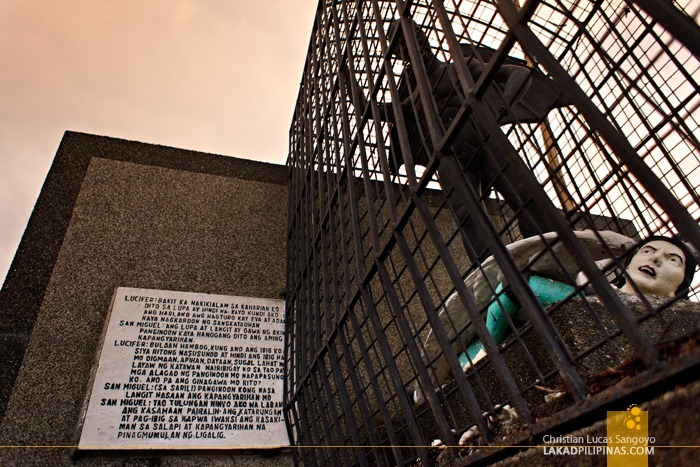
The cemetery a few hundred steps away from the place where I grew up has a secret.
We used to jump along its tombs during hot summer days when there was nothing else to do and my friends used to fly kites from the highest mausoleums on October months where the wind is at its strongest. My grandfather, who now rest inside its hallowed grounds, used to take walks here every morning where I occasionally accompany him.

The original plan of shooting the old Manila Chinese Cemetery for this year’s All Saints’ Day was abruptly cancelled (just temporally, it still pushed through later). We were weaving through the traffic of people along M.H. Del Pilar and the thought of swimming further on a sea of humanity along Rizal Avenue was just not that appealing. We headed towards the opposite direction and boarded a jeep going to Malabon’s Bayan instead.
I hazily recall, from years past, of a huge church with a cemetery right beside it. The new plan was to check out the scene at the graveyards at Bayan then revisit Malabon’s old church.

It’s been drizzling on and off the whole day, not really the best weather for one of the major holidays in the Philippines. As the western part of the world celebrates Halloween, the Filipino people celebrate All Saints’ Day. 
Wikipedia defines All Saints’ Day as the day Christians celebrate all the saints of the church, both known and unknown. The following day, November 2nd which is All Souls’ Day, commemorates the departed faithful who have not yet been purified and reached heaven.
METRO MANILA | Simbang Gabi at Malabon's Sacred Heart Parish
[ARCHITECTURE] Tuesday, December 22, 2009
In olden times, it was called Misa de Gallo, which translated means Mass of the Rooster. The rooster serving as a signal for the people to wake up and go to mass.
You might be asking, what prompted the people to get up so early during the cold December dawn just to get to mass?
The tradition started out in 1669 when a Spanish priest held a mass for farmers wanting to attend the Christmas advent, however, we’re unable to since they need to tend to their fields early in the morning.
Today, the tradition still holds strong is still very much alive. It is is usually one of the things Filipinos anticipate during the Holidays. A few even hold on the the belief that if you complete the nine days of Simbang Gabi, a wish will be granted.
We’ve still got a few more days left before Christmas; so get up early, wear your thickest jacket, attend a Simbang Gabi, and have your treat of hot Putobumbong’s, and steaming Bibingka’s afterwards.


